1
Measure
Acquire ECG and finger PPG simultaneously under the same resting conditions.
A two-sensor system that connects the electrical onset of each heartbeat to the delayed arrival of the peripheral pulse wave.
KardioAS Dual records ECG (electrocardiogram) from a chest sensor and PPG (photoplethysmography) from a finger sensor in one synchronized study. ECG marks the electrical start of the beat, while PPG shows when the pulse wave reaches the finger. By measuring the delay between these two events, the system opens a practical way to study pulse arrival, vascular propagation and beat-to-beat cardiovascular dynamics.

KardioAS Dual is designed for situations where it is useful to go beyond heart rate alone. The system helps visualize how the heartbeat generated by the heart is translated into a peripheral pulse detected at the finger.
This makes the platform attractive for preventive observation, vascular-function screening, repeated follow-up and educational or research-oriented cardiophysiology workflows. The synchronized display also helps the practitioner explain the meaning of the measurement to the patient in a very intuitive way.
Acquire ECG and finger PPG simultaneously under the same resting conditions.
Calculate Pulse Arrival Time and derive protocol-specific vascular timing indicators.
Compare studies over time and observe trends in vascular response and signal agreement.

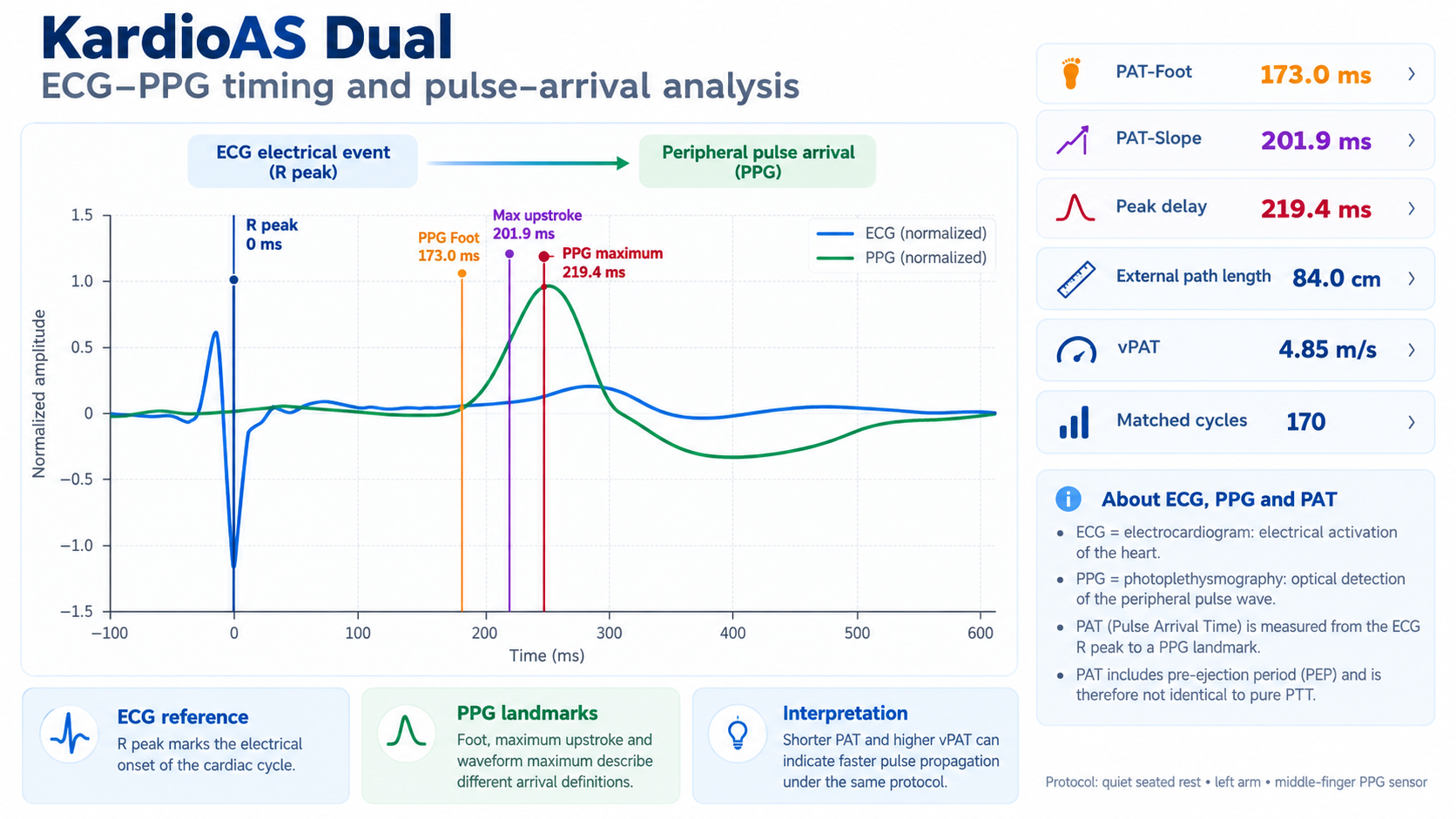
In KardioAS Dual, the ECG channel provides the timing reference for each cardiac cycle — typically the R peak of the QRS complex. The PPG channel records the peripheral pulse wave at the middle finger and identifies characteristic landmarks such as the Foot, the steep upstroke and the waveform maximum.
PAT means Pulse Arrival Time. In practice, the main timing reference is usually the delay from the ECG R peak to the Foot of the PPG wave. The software can also analyze additional landmarks such as the point of maximum upstroke and the pulse maximum.
Because the ECG reference happens earlier than the peripheral pulse, this delay contains valuable physiological information. Under standardized conditions, a shorter arrival time usually corresponds to faster pulse-wave propagation, while a longer delay corresponds to slower propagation.
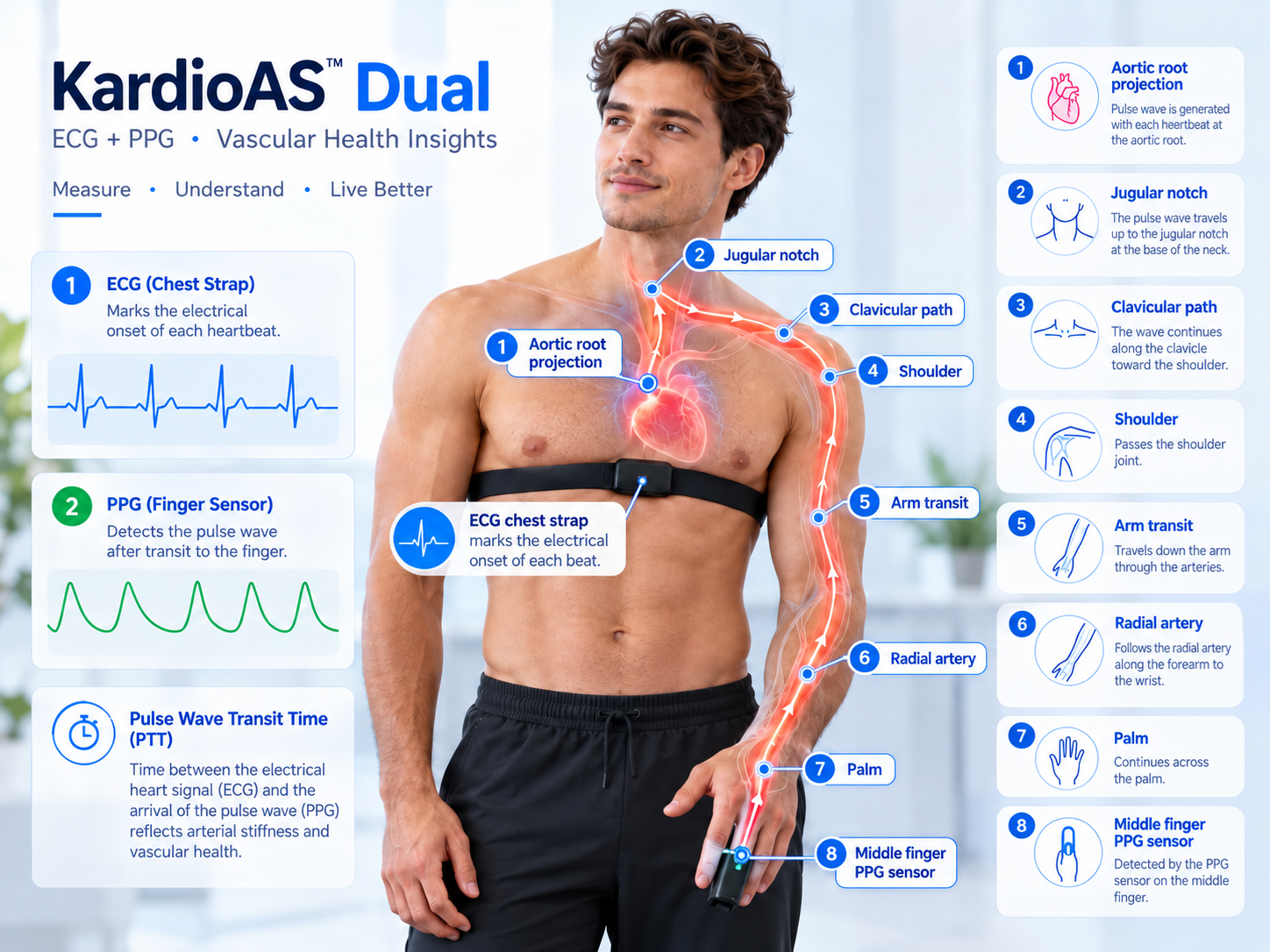
After each electrical heartbeat, the pulse wave originates near the aortic root, reaches the suprasternal (jugular) notch region, continues through the clavicular and shoulder area, propagates down the arm along the arterial tree, and finally reaches the palm and the middle finger where the PPG sensor detects it.
KardioAS Dual does not try to hide this route: it makes it visible and understandable. This improves interpretation and helps connect the measured delay to real vascular propagation rather than to an abstract software number.
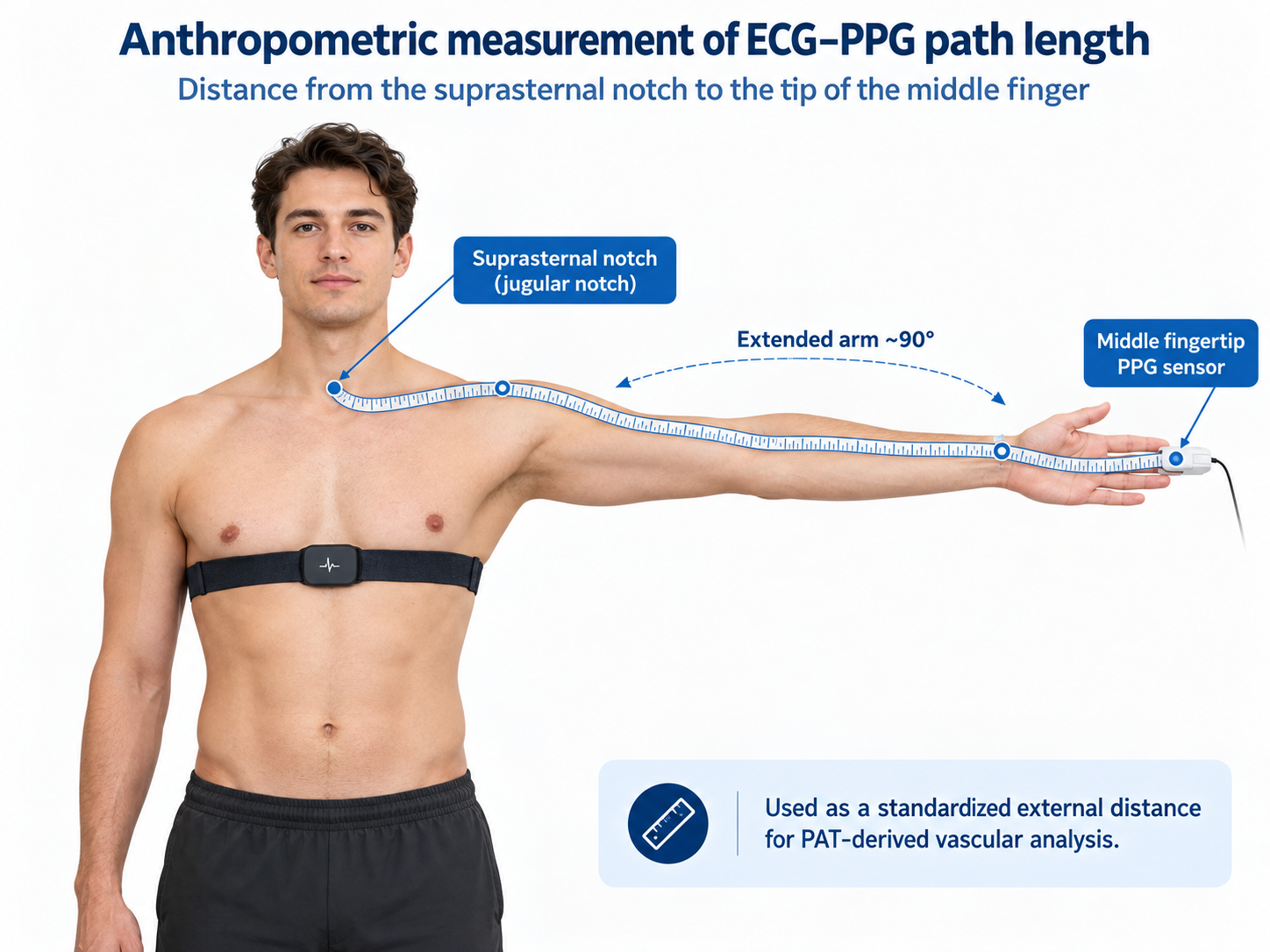
To estimate a protocol-specific propagation speed, KardioAS Dual uses an anthropometric path-length measurement. The current approach measures the external distance from the suprasternal notch to the tip of the middle finger with the arm extended at approximately 90°.
Keeping the path measurement standardized is important, because velocity is calculated from the relation between distance and time delay. Repeating the same protocol under similar resting conditions improves study-to-study comparability.
KardioAS Dual is not only about one calculated number. It is a complete dual-sensor workflow that helps acquire, explain, compare and monitor cardiovascular timing data.
Chest ECG and finger PPG are acquired in one coordinated study.
Analyze R-to-PPG timing and several peripheral landmarks, including Foot and waveform maximum.
Combine standardized path length with timing metrics to estimate effective pulse-wave speed.
Compare R–R intervals and pulse-to-pulse intervals to evaluate concordance between the channels.
Store results, compare studies and follow changes over time in a structured workflow.
The application supports English, Lietuvių, Polski, Español, Deutsch, Français, Italiano and Русский.
Short answers for readers who want to understand what KardioAS Dual measures and why the two-sensor approach is useful.
A standard ECG focuses on the electrical activity of the heart. KardioAS Dual adds a synchronized finger PPG channel, so it can measure not only when the heart is activated electrically, but also when the pulse wave actually reaches the periphery.
PAT stands for Pulse Arrival Time. It is the delay between an ECG reference event (usually the R peak) and a selected landmark of the peripheral PPG wave.
An external anthropometric distance is needed when timing is translated into a velocity-related index. Using the same path and the same measurement protocol improves repeatability.
Yes. One of the important strengths of KardioAS Dual is dynamic observation — repeated measurements under similar conditions can be compared over time to monitor changes in vascular timing and response.
Yes. The platform supports eight interface languages: English, Lithuanian, Polish, Spanish, German, French, Italian and Russian.
The system can be useful for preventive cardiovascular observation, educational demonstration, research-oriented measurement and longitudinal vascular-function assessment in a practical outpatient-style workflow.
If you would like to learn more about the system, discuss collaboration, request details or ask about implementation, we will be glad to hear from you.