⌁
Forearm or upper arm
A soft armband holds the optical sensor securely against the skin. Polar recommends these arm locations, rather than the wrist.
Comfortable optical pulse analysis for everyday use.
KardioAS V connects an Android smartphone to the Polar Verity Sense optical sensor. It records the real PPG signal, evaluates pulse-to-pulse intervals, reviews signal quality and turns selected recordings into structured physiological analyses — while keeping the sensor wearable and unobtrusive.
Wearable, contact-based optical measurement — no chest electrodes or finger clip required.
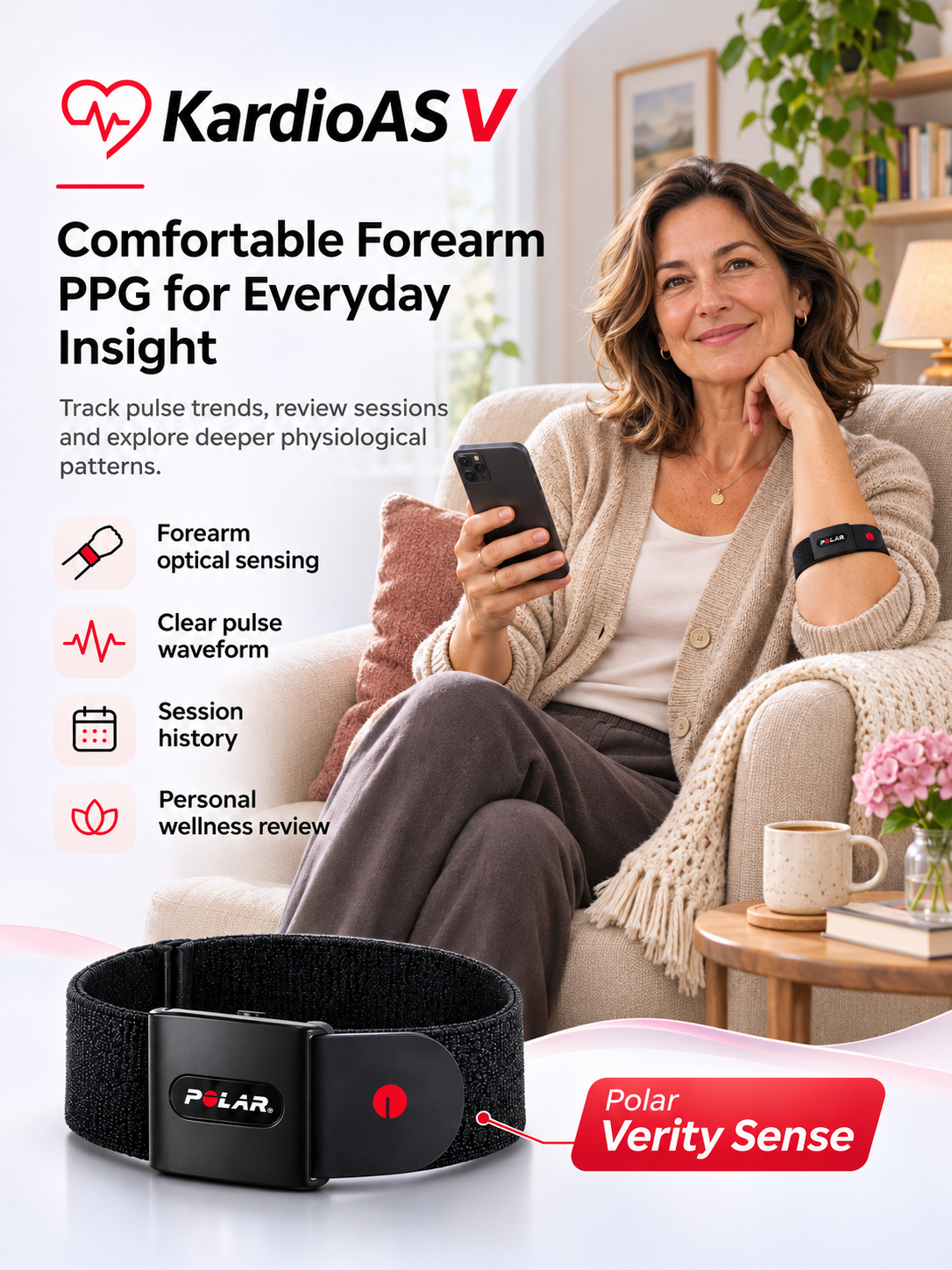
The sensor measures the pulse optically through the skin. Its rechargeable, compact form factor lets people make recordings at home, at rest or after activity without using adhesive ECG electrodes.
A soft armband holds the optical sensor securely against the skin. Polar recommends these arm locations, rather than the wrist.
Polar also supports placement against the temple using the swimming-goggle strap clip. A suitable fitting must maintain firm skin contact.
Bluetooth Low Energy carries the signal to the Android application without a direct USB connection to the body-worn sensor.
Useful for comfortable seated or reclining sessions, repeated follow-up and gentle post-activity monitoring.
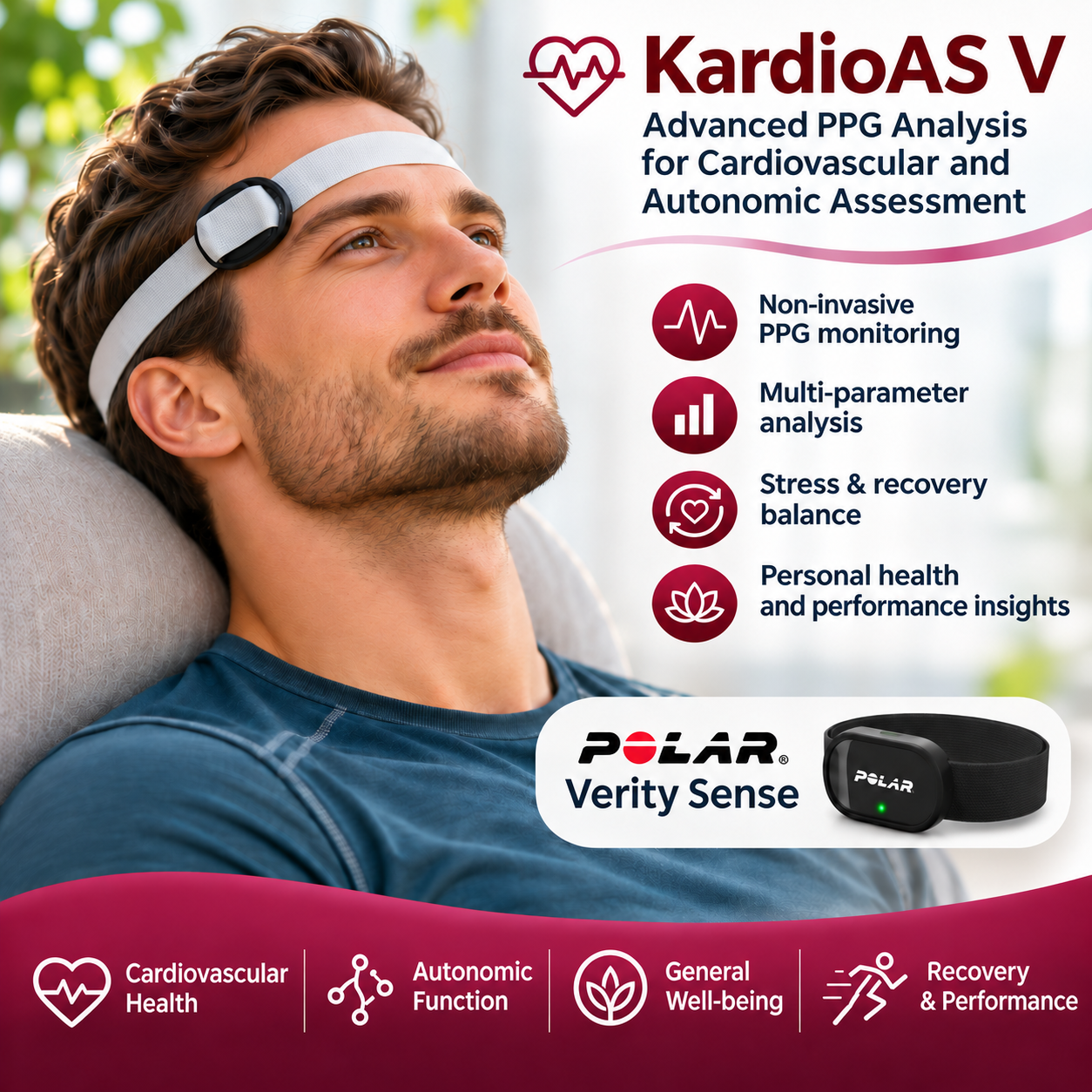
Choose a comfortable position, attach the sensor securely and check the live waveform before recording. Standard use is on the forearm or upper arm with the armband; Polar also supports temple placement with the approved clip arrangement when stable skin contact is maintained.
¹ Hardware characteristics from Polar. Recording quality varies with movement, fit, skin contact and measurement conditions. For temple use, follow the manufacturer's mounting instructions and verify stable optical contact.
Polar Verity Sense uses reflectance photoplethysmography (PPG). LEDs illuminate the skin; a photodetector reads changes in the light reflected back from tissue. Those changes follow pulsatile blood-volume variations related to each heartbeat.
The resulting optical waveform differs from ECG, which measures the heart's electrical activity. Pulse timing is useful, but a PPG interval is not identical to an ECG R–R interval.
The forearm/temple optical signal and the acquisition setup are not used for detailed pulse-wave morphology analysis. Fine wave-contour features, notches and reflected-wave parameters cannot be reliably evaluated as in KardioAS P with its dedicated finger sensor. KardioAS V focuses on cleaned pulse timing, variability, trends and exploratory profiles instead.
Diagrams illustrate the difference in signal origin; they are not clinical traces.
Raw measurements are preserved separately from the filtered signals used for analysis. This helps distinguish genuine optical pulse timing from noise, movement artifacts and unreliable intervals.
Discover Polar Verity Sense through Bluetooth LE and acquire the four-channel raw PPG stream at approximately 55 samples per second.
Keep the optical channels and time information available for subsequent review, rather than overwriting the original samples.
Apply baseline correction and smoothing during analysis, review signal quality and identify plausible optical pulse peaks.
Compare real-time and offline pulse intervals, flag gaps or uncertain beats and avoid treating invented intervals as measured data.
Open the full analytical modules, compare saved studies and prepare a structured PDF report.
A smooth-looking graph is not enough to establish reliable physiological data. KardioAS V combines optical signal review, artifact awareness and interval-quality checks. Data that fail quality criteria can be excluded from analysis.
KardioAS V brings acquisition, recording and interpretation into one Android workflow. The app displays the pulse signal while the sensor is connected, stores recordings in a patient-based registry and opens selected studies in Full Analysis.
KardioAS V keeps the workflow straightforward: connect the sensor, verify signal quality, record the study, and then continue with review and interpretation in the analysis modules.
While the sensor streams data, KardioAS V displays the optical pulse waveform, current heart rate in beats per minute (bpm) and pulse-to-pulse interval duration in milliseconds (ms).
The live view also shows sensor connection, battery status and optical signal quality. Switching between raw and filtered PPG helps check the signal before starting a recording.
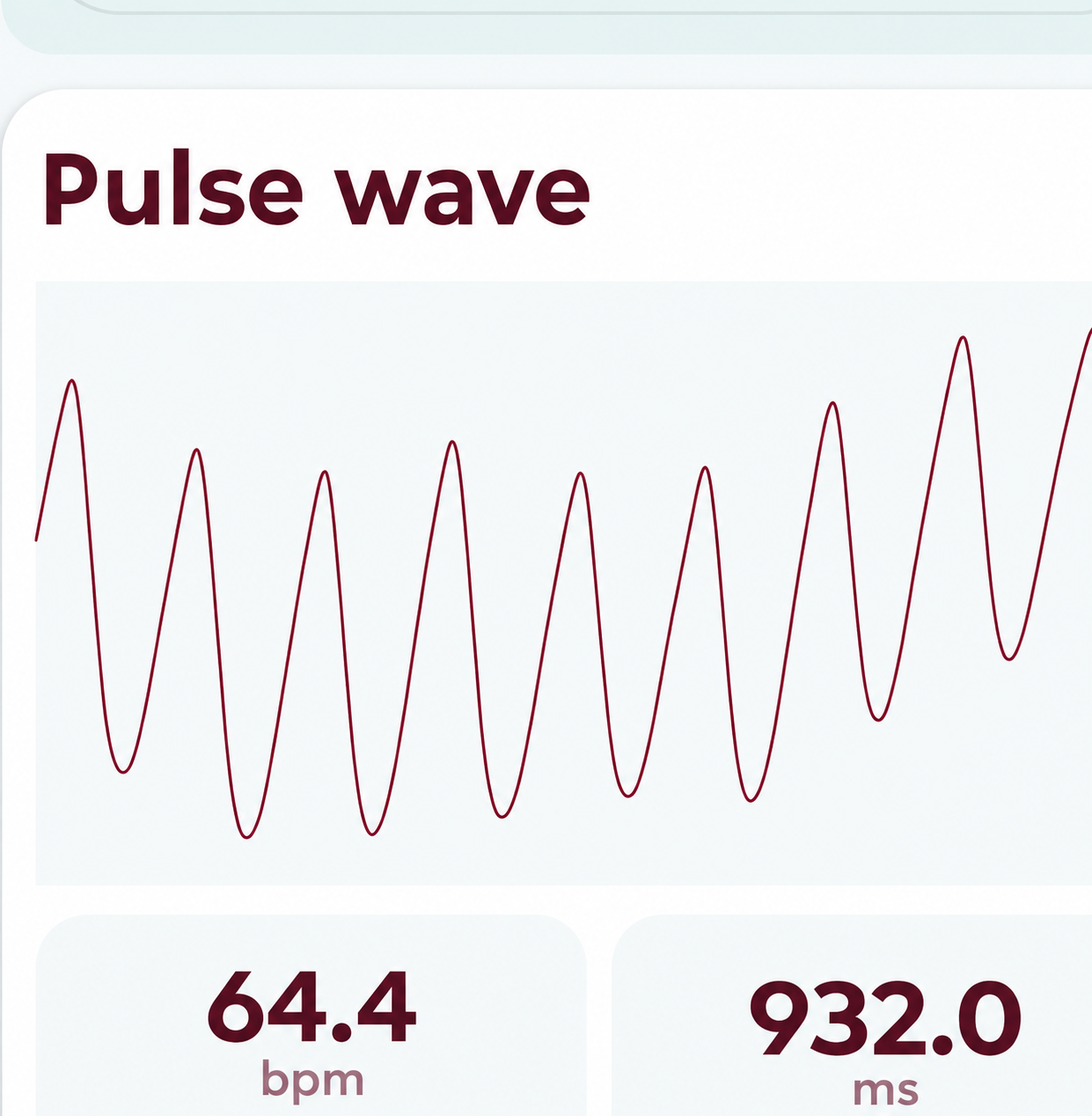
The software includes interval-based and research-oriented profiles. The available analyses depend on the quality of the saved optical pulse sequence and should be interpreted in the context of PPG, not as equivalent to ECG diagnosis.
Time-domain variability, pulse interval distribution, frequency-domain features and the Baevsky stress index computed from valid optical intervals.
Time-domain, frequency-domain and stress-index metricsComposite cardiovascular-oriented indicators and contextual interpretation based on interval-derived measurements.
Integrated cardiovascular indicatorsPulse rhythm regularity and interval-pattern screening, with statements about the quality and structure of the detected pulse sequence.
Beat-to-beat rhythm overviewPulse-modulation patterns that can support exploratory respiratory-related estimates under stable conditions.
Respiration-linked pulse dynamicsInterval variability and regulatory-balance indicators for research-oriented analysis of autonomic responses.
Autonomic response trendsExperimental interpretations of patterns associated with physiological activation and recovery.
Physiological activation and recovery contextTraditional-framework exploratory interpretations derived from pulse-interval features.
Traditional perspectives on pulse-interval patternsTraditional Chinese Medicine–inspired exploratory pattern descriptions for educational use.
TCM-inspired interval pattern reviewReview saved studies, compare compatible recordings over time and export structured reports for documentation.
Longitudinal review and exportable reportsAll profiles are derived from optical PPG-based interval data and support physiological observation, comparative study and trend review. Recording quality and measurement conditions are considered when interpreting the results.
A single wireless sensor supports measurements during quiet rest and after activity. The Android application keeps the pulse signal, session history and analysis tools together for repeated observations.
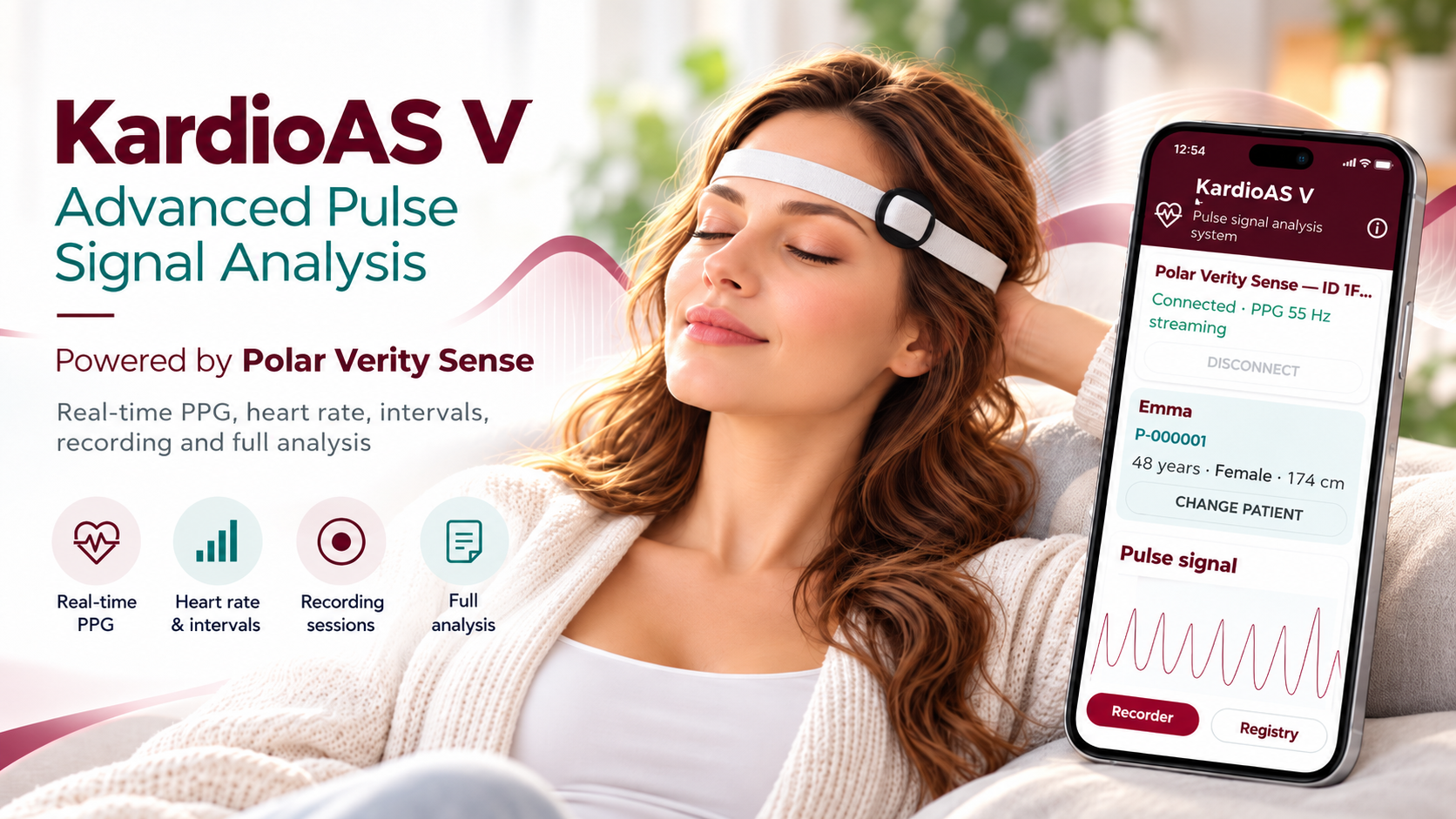
Polar Verity Sense streams the pulse signal wirelessly, while KardioAS V filters the waveform and calculates pulse intervals. Saved sessions can be reviewed in Full Analysis to assess rhythm variability and changes over time.
Because these measurements originate from reflected light rather than ECG electrodes, interpretations remain focused on optical pulse timing and its variability.
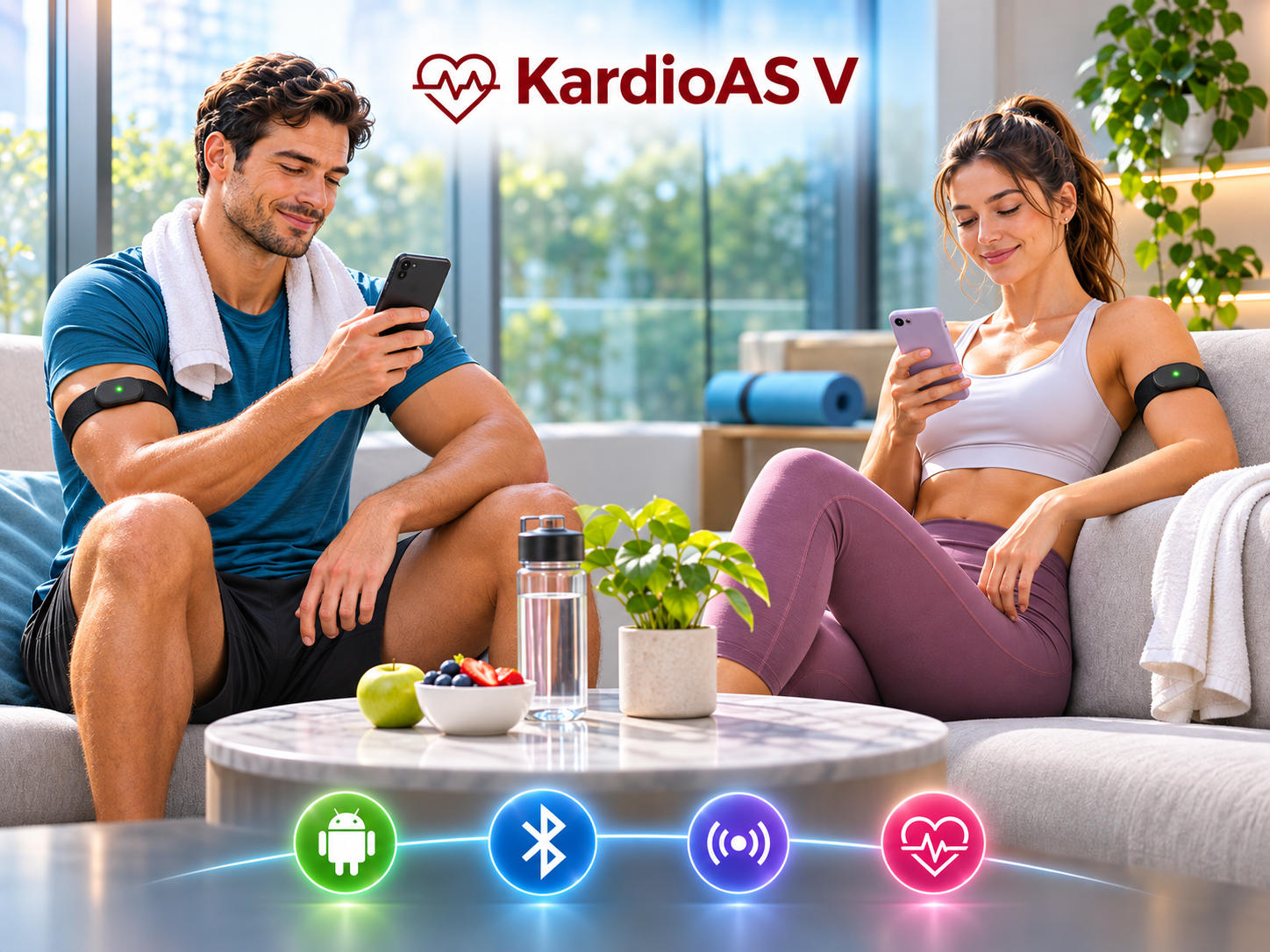
KardioAS V is not limited to quiet home sessions. Once movement settles, the system can be used after light exercise or training to observe pulse timing, recovery trends and changes across repeated sessions.
As always, the recording should be reviewed for artifacts and interpreted according to signal quality.
Each KardioAS product is built around a distinct acquisition method. The analysis should always respect the signal actually measured by the sensor.
| System | Acquisition | Particular strength | Important distinction |
|---|---|---|---|
| KardioAS V | Wearable reflected-light PPG | Comfort, wireless recording, PPI / PRV and analysis | No detailed pulse-wave morphology |
| KardioAS M | 3-electrode wired ECG | Electrical cardiac signal and ECG-based HRV | Requires electrodes and USB |
| KardioAS P | Dedicated finger PPG | Pulse-wave contour and morphology analysis | Finger-mounted sensor |
| KardioAS Dual | Synchronized ECG + finger PPG | Cross-signal timing / pulse arrival | Two sensors required |
Good interpretation begins with knowing what the sensor can and cannot measure.
No. It streams optical photoplethysmography (PPG) from Polar Verity Sense. It does not measure electrical P/QRS/T complexes or deliver ECG-based diagnoses.
No. Unlike the dedicated finger PPG acquisition in KardioAS P, this optical wearable setup is not intended for accurate contour landmarks, dicrotic notches or reflected-wave morphology parameters.
Polar supports temple placement with its swimming-goggle strap clip. An alternative strap must keep the optical window in direct, secure skin contact. The manufacturer recommends forearm or upper arm for standard armband use.
No. Pulse rate variability (PRV) is calculated from peripheral optical pulse intervals; classical HRV uses ECG R–R intervals. They may track related physiology but can diverge, particularly with motion or changing vascular conditions.
The software reviews interval plausibility and signal quality. Uncertain or incomplete intervals should not be treated as measured beats. For best repeatability, record at rest with the sensor snugly placed.
The described analyses are intended for information, education and research-oriented interpretation. The application does not replace a qualified professional, ECG examination or validated clinical diagnostic equipment.
KardioAS V is independent Android software designed to work with Polar Verity Sense. Polar Electro is the manufacturer of the sensor and is not represented as the developer or endorser of KardioAS V.
Ask about system availability, device-specific installation, measurement protocols or research collaboration.